Oven Baby Back Ribs
with a Sticky Broiled BBQ Finish
“No smoker. No fuss. Off the bone.”
Somewhere out there, someone with an expensive smoker is checking a temperature probe every twenty minutes and worrying about wood chips. Meanwhile your oven — the one you already own — is fully capable of ribs that surrender off the bone. It just needs foil, patience, and almost no supervision until the broiler comes on.
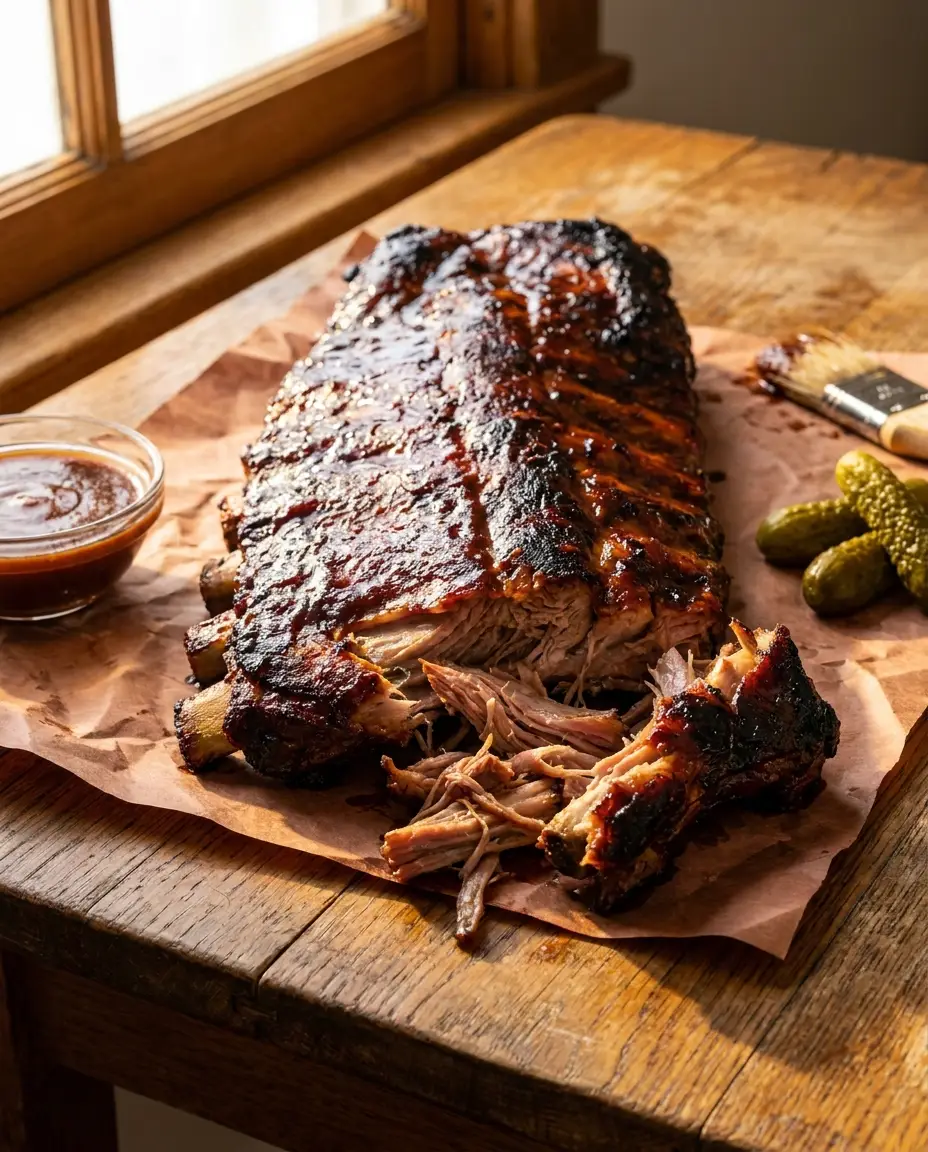
The method is honest physics: a spice rub, a tight foil wrap, and 2½ low-and-slow hours where the ribs braise in their own steam until the collagen gives up beautifully. Then the broiler paints on the sticky lacquered finish that makes everyone assume you own equipment you don't.
🍖 The promise: fall-off-the-bone ribs with a sticky broiled lacquer — 15 minutes of your effort, 3 hours of the oven's, zero smoker.
How to make it
View ingredient overview

🧂 Ingredient notes & easy swaps
🍳 What you actually need (equipment)
Heat the oven to 275°F (135°C). Flip the racks bone-side up and peel off the membrane — butter knife under the corner, paper-towel grip, one pull. This is the step that separates good ribs from great ones.
Mix the rub (brown sugar, paprika, garlic and onion powders, mustard, salt, pepper) and massage it over every surface of both racks.
Wrap each rack tightly in a double layer of foil — sealed like a gift you don't want leaking — and lay them meat-side up on the sheet pan.
Bake 2½ hours. Do nothing. The foil traps the ribs' own moisture into a self-basting steam bath while the collagen slowly melts into silk.
Open the foil carefully (real steam!) — the meat should have pulled back from the bone tips and a rack should bend deeply when lifted with tongs. Stir the BBQ sauce with the vinegar and honey and brush a generous coat over the meat side.
Broil 3–5 minutes, watching like a hawk, until the glaze bubbles and chars at the edges. Second coat, 2 more broiler minutes if you like it lacquered thick. Rest 5 minutes, then flip the rack bone-side up so you can see where the bones run and slice between them.
✅ How to know the ribs are done
The bend test tells all: lift a rack with tongs from one end — it should bow deeply and threaten to crack at the middle. Meat pulled back from the bone tips by ¼ inch, a knife sliding between ribs with zero argument, glaze bubbled and spotted dark. Pork is safe to eat at 145°F (63°C) with a 3-minute rest, but ribs are not tender until well past that: a thermometer slid into the meat between two bones should read about 195–203°F (90–95°C), which is where the collagen has turned to gelatin. If it bends stiffly or reads under 190°F, rewrap and give it 30 more foil minutes — ribs forgive patience, never haste.
💡 Practical tips (and what not to do)
- Peel the membrane. Always. It's the difference between rub-flavored silk and gnawing through parchment — one pull, done forever.
- Double-wrap the foil. One pinhole leak lets the steam — and the tenderness — escape. Seal it like it's classified.
- 275°F is the number. Hotter squeezes the moisture out before the collagen melts; low-and-slow is the entire contract.
- Sauce only at the end. Sugar can't survive 2½ oven hours — glaze meets heat for minutes, not hours.
- Stay at the oven for the broil, door cracked. The sugar in the glaze goes from bubbling and lacquered to black in about 40 seconds.
🔁 Easy variations (budget · lighter · kids · extra flavor)
💛✨ Flavor boost
The foil wrap. It turns your oven into a braising chamber: the ribs steam in their own rendered juices at exactly the temperature where collagen dissolves into gelatin — which is the literal substance of "fall-off-the-bone." Pitmasters call it the Texas crutch and use it on smokers too. Foil, patience, physics: that's the entire mystery.
🌽 What Goes Well With It
- Corn on the cob and a stack of napkins — rib night protocol.
- A sharp vinegar slaw to cut through the sticky richness.
- Baked beans if you're committing to the full cookout indoors.
- Pickles and white bread — the barbecue-joint touch that costs nothing.
📦 Storage & Freezer Notes
- Fridge: 4 days, wrapped tightly in foil or in a sealed container; keep the racks whole rather than cut so the meat dries less.
- Freezer: cut into 3- or 4-bone sections, wrap tightly in foil and then a freezer bag, up to 3 months; thaw overnight in the fridge before reheating.
- Reheat wrapped in foil with a spoonful of water at 300°F (150°C) for 20 minutes until hot through, then brush on fresh glaze and broil 2 minutes. The foil and water keep the meat from drying; a microwave heats the sugar in the glaze faster than the meat and leaves the outside tacky and the inside lukewarm.
❓ Quick answers
Baby backs or spare ribs — what's the difference?
Can I make them ahead for a party?
Why are my ribs tough?
Do I really need to remove the membrane?
🥗 Nutrition, roughly: about 620 calories per half-rack. Estimates only; brands, cuts and portion sizes change the numbers.