Chocolate Mug Cake for Two
with Melty Chocolate Chips
“Two mugs, one fork each, molten middle.”
This is the late-evening chocolate cake: enough for two people, made from flour, sugar, cocoa, milk and oil that are already in the cupboard, mixed with a fork directly in the mugs and cooked one mug at a time in the microwave. There is no pan to wash and no leftover cake.
It has no egg on purpose. In a cake this small, one egg is far too much protein, and microwaved egg is what makes most mug cakes rubbery; oil and milk keep this crumb soft. A spoonful of chocolate chips pushed under the surface melts into a molten centre while the cake around it sets.
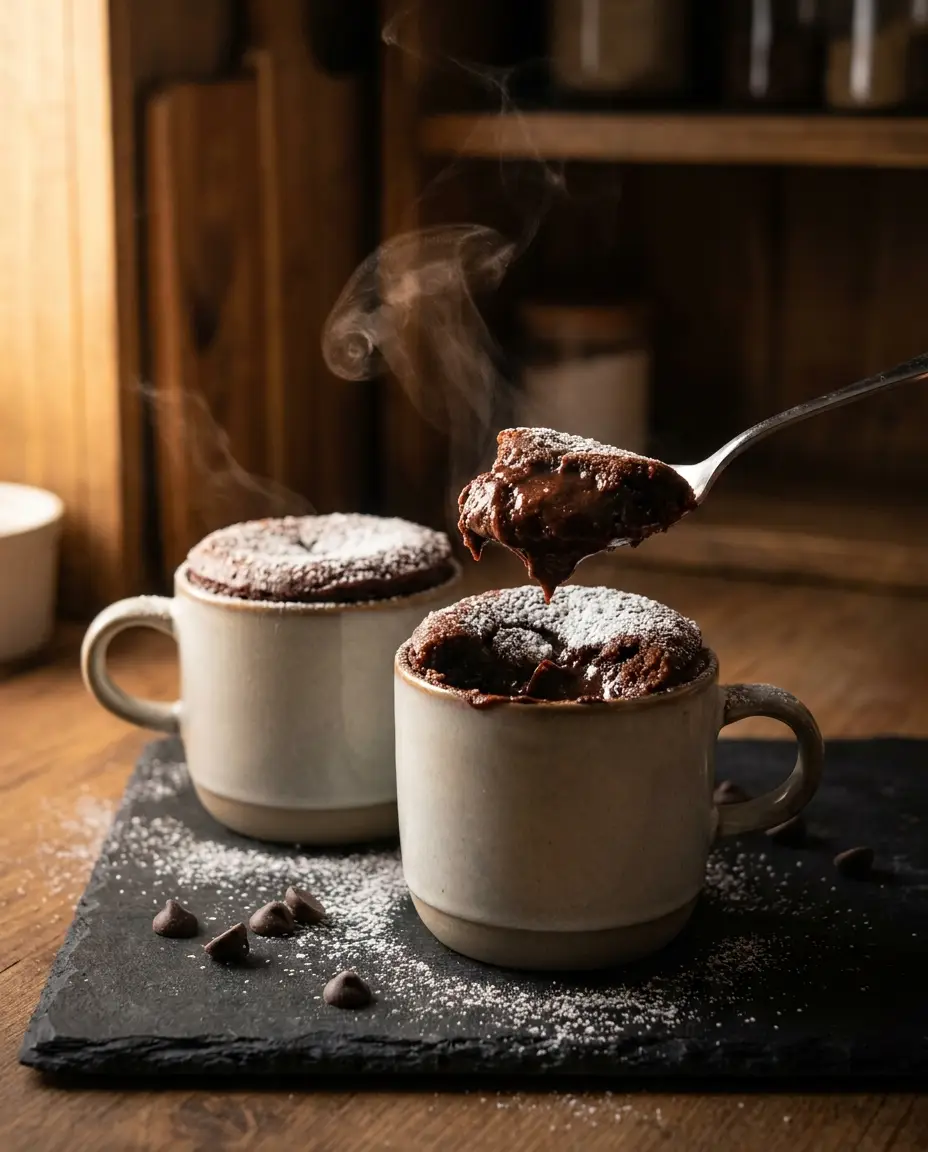
The promise: about seven minutes, two mugs, one fork each, and a soft chocolate cake with a molten middle.
How to make it
View ingredient overview

🧂 Ingredient notes & easy swaps
🍳 What you actually need (equipment)
Whisk the dry, right in the mugs. Into each mug: 4 tablespoons flour, 2 tablespoons sugar, 1 1/2 tablespoons cocoa, 1/8 teaspoon baking powder (half the total), and a small pinch of salt. Stir with a fork until no pockets of cocoa or flour hide at the bottom.
Add the wet. Into each mug: 3 tablespoons milk, 1 1/2 tablespoons oil, and 1/4 teaspoon vanilla. Stir until just smooth, scraping the fork around the bottom edge where dry flour collects.
Bury the chocolate chips. Drop a tablespoon of chocolate chips into the center of each mug and push them just under the surface. Do not stir them in; they need to stay clustered to become the molten middle.
Microwave ONE mug at a time, 60 to 75 seconds on full power. The cake will rise well above the batter line, then settle. It is done when the top looks set but still glossy at the very center. Cook the second mug the same way.
Resist the extra seconds. A slightly shiny centre spot is the goal; that is the melted chip cluster. The cake keeps cooking from its own heat after the microwave stops, so an extra 30 seconds to be safe is the most common reason a mug cake comes out dry and rubbery.
Rest one minute, then top and serve. Dust with powdered sugar, or drop a small scoop of vanilla ice cream into the dip in the middle. Eat warm from the mug with a spoon; the cake turns dense once it cools.
✅ How to know the mug cake is done
The top should be set and springy at the edges with a small glossy spot in the middle; that spot is the melted chip cluster, not raw batter. If the whole top is wet, give it 10 more seconds and check again. If it looks dry and cracked across the top, it is overcooked; the crumb will be firm, and a scoop of ice cream helps.
💡 Practical tips (and what not to do)
- One mug at a time in the microwave. Two mugs share the microwave's power and both cook unevenly, with one raw side each; 70 seconds apiece is still quick.
- Check at 60 seconds, then add 10 at a time. Microwave wattage and mug shape both change the timing. Once you know your machine's number, it is the same every time.
- Do not stir in the chips. Clustered chips melt into a molten centre; stirred chips disappear into the crumb.
- Level the cocoa and flour. A heaped spoon of cocoa in a cake this small makes it dry and bitter; a heaped spoon of flour makes it tough. Level the spoons with a knife.
- Other fillings work the same way: a teaspoon of peanut butter dropped in with the chips, a soft caramel, or three mini marshmallows, all pushed just under the surface.
💛✨ Flavor boost
Add a small pinch of instant espresso powder or an extra pinch of salt to the dry ingredients in each mug. Neither makes the cake taste of coffee or salt at this amount; both make the cocoa taste more like chocolate, which matters in a cake with only 1½ tablespoons of cocoa per mug and no butter to carry the flavor.
🍨 What Goes Well With It
- A small scoop of vanilla ice cream melting into the warm middle.
- Cold milk.
- A few raspberries or sliced strawberries on top, for something sharp against the chocolate.
- A spoonful of whipped cream and a little extra cocoa dusted over.
📦 Storage & Freezer Notes
- It does not keep. A mug cake is tender for about 20 minutes and turns dense and dry as it cools; reheating does not bring it back. Make it when you will eat it.
- Prep ahead: measure the dry ingredients into two mugs or small jars in advance. Add the milk, oil and vanilla, stir, and microwave when wanted.
- Doubling: do not double within one mug; the batter rises to nearly twice its height and will overflow. More people means more mugs, cooked one after another.
🧒 Serving Ideas for Kids
- Children can measure and fork-whisk their own mug; an adult handles the microwave and the hot mug.
- Dry-mix "cake kits" in small jars work well for sleepovers: each child adds milk, oil and vanilla to their own jar's contents in a mug.
- Do not skip the one-minute rest for children: the chocolate centre is much hotter than the cake around it straight out of the microwave.
❓ Quick answers
Why did my mug cake come out rubbery?
Can I make it in the oven instead?
Can I make it dairy-free or gluten-free?
Is the raw batter safe to taste without eggs?
🥗 Nutrition, roughly: about 350 calories per mug with 5g protein, 46g carbs, and 17g fat, without the ice cream. Estimates only; brands, cuts and portion sizes change the numbers.